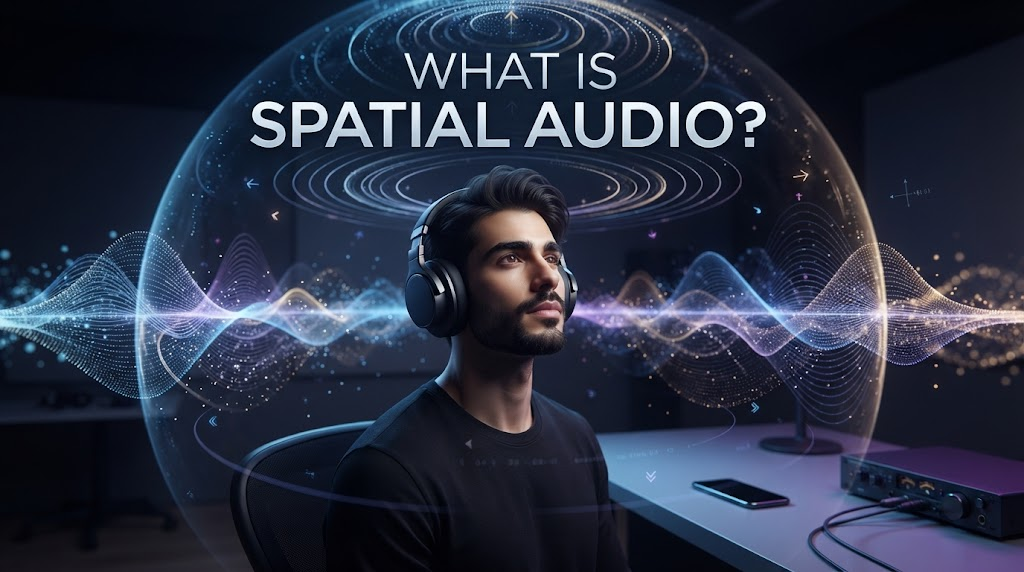
If you have ever watched a movie where a helicopter seems to fly overhead, heard a singer appear to stand directly in front of you, or noticed game sounds coming from different directions, you may have experienced spatial audio. But what is spatial audio, and how is it different from ordinary stereo sound?
Spatial audio is an immersive audio technology designed to make sound feel as though it exists around you in three-dimensional space. Instead of simply separating sound into left and right channels, spatial audio can create the perception of sounds coming from the front, sides, rear, and even above the listener.
Today, this technology is used in movies, music, video games, virtual reality, video calls, and other digital experiences. Apple, Dolby, and other technology companies support different forms of immersive audio across modern devices.
What Is Spatial Audio?
So, what is spatial audio in simple terms? It is a method of producing and processing sound so that listeners perceive audio as coming from specific locations around them.
Traditional stereo generally creates a left-right soundstage. Spatial audio goes further by attempting to reproduce a three-dimensional sound environment. A compatible recording can place individual sounds at different positions, creating a more realistic sense of space.
For example, imagine watching a movie scene in which rain falls around a character while a car approaches from behind. With spatial audio, the sound designer can make the rain feel surrounding while the vehicle appears to move through the sound field.
This makes the listening experience feel less like audio coming from speakers and more like being inside the scene.
How Does Spatial Audio Work?
Understanding what is spatial audio also requires understanding how the technology creates the illusion of location.
Spatial audio can use information about the direction, distance, movement, and height of sounds. Audio processing then converts that information into signals suitable for headphones, speakers, soundbars, or home theater systems.
One important approach is object-based audio. In a Dolby Atmos production, for example, sounds can be treated as objects positioned within a three-dimensional environment. Apple explains that spatial audio mixes can position and move audio objects so they appear to come from different directions around the listener.
Headphones can create a convincing three-dimensional effect through binaural processing. Instead of physically placing speakers around your head, software modifies the sound reaching each ear to simulate the acoustic cues your brain uses to determine where a sound originates.
What Is Spatial Audio With Head Tracking?
A particularly advanced feature is dynamic head tracking. This helps explain why what is spatial audio can mean more than simply “surround sound.”
With head tracking, the audio environment can remain anchored to a device or virtual location while you move your head. If a sound appears to come from your phone or computer screen and you turn your head, the perceived position of the sound can change accordingly.
Apple describes Spatial Audio with head tracking as an immersive experience in which supported audio can seem to remain fixed relative to the device while the listener moves.
This can make movies and music feel more natural because the soundstage appears to have a stable position instead of simply moving with your headphones.
What Is Spatial Audio Used For?
Now that we understand what is spatial audio, it is easier to see why the technology has become popular.
Movies and TV
Movies are one of the most obvious applications. Spatial audio can make explosions, vehicles, voices, environmental sounds, and music appear to originate from different positions.
Instead of hearing every sound from a general left-right field, viewers can experience a larger and more immersive soundscape.
Music
Spatial audio has also become increasingly important in music. Compatible recordings can place vocals and instruments within a three-dimensional sound field.
Apple Music, for example, offers selected songs in Dolby Atmos, which Apple describes as creating an immersive three-dimensional listening experience.
This can give listeners the impression that instruments occupy different areas around them rather than existing inside a flat stereo image.
Gaming
Gaming benefits significantly from positional audio. Hearing footsteps, vehicles, environmental effects, or gunfire from specific directions can help players understand what is happening around them.
In games designed for immersive audio, sound can contribute to both realism and situational awareness.
Virtual and Augmented Reality
Spatial audio is especially useful in virtual reality because the audio needs to correspond with the user’s virtual surroundings. When a virtual character speaks from behind you, the sound should appear to come from that direction.
This synchronization between visual and auditory information can make virtual environments feel more convincing.
Spatial Audio vs. Stereo Sound
A common question after learning what is spatial audio is how it differs from stereo.
Stereo primarily uses two channels, generally representing left and right. Engineers can use those channels creatively to create a wide soundstage, but the basic system is still based around two-channel playback.
Spatial audio can simulate a much broader three-dimensional environment. Depending on the format and playback system, sound may be perceived as coming from different horizontal directions and from above or below.
That does not automatically mean spatial audio is always better. A well-produced stereo recording can sound excellent, while a poorly produced immersive mix may not be particularly impressive.
The quality of the recording, mixing, mastering, playback hardware, and listener preferences all matter.
Is Spatial Audio the Same as Dolby Atmos?
No. This distinction is important when researching what is spatial audio.
Spatial audio is a broad concept describing immersive three-dimensional sound experiences. Dolby Atmos is a specific audio technology and format used to create and deliver immersive sound.
In other words, Dolby Atmos can be used to deliver spatial audio, but the terms are not perfect synonyms.
Spatial audio can also refer to other technologies, processing systems, and playback approaches designed to create the perception of three-dimensional sound.
Do You Need Special Headphones for Spatial Audio?
Not necessarily. The requirements depend on the particular spatial audio technology, content, and device.
Some spatial audio experiences work through compatible headphones using software-based processing. Others are designed for soundbars, receivers, or multi-speaker home theater systems.
Apple, for example, supports Spatial Audio and head tracking on certain AirPods models and compatible Apple devices.
However, having compatible hardware does not guarantee that every piece of content will use spatial audio. The content itself must generally support the relevant format or processing method.
Is Spatial Audio Worth Using?
Whether spatial audio is worthwhile depends on what you listen to and how you prefer your sound.
For movies and games, immersive audio can make environments feel more convincing. For music, some listeners enjoy the additional space and separation, while others prefer traditional stereo because it can sound more familiar or focused.
The best approach is to listen to the same content in stereo and spatial audio when both versions are available. Your personal preference matters more than marketing terminology.
It is also important to remember that spatial audio is not the same as lossless audio. Lossless describes how accurately audio data is preserved, while spatial audio concerns how sound is presented spatially. Apple treats these as separate audio features.
How to Experience Spatial Audio
If you want to try spatial audio, start with content specifically produced or labeled for an immersive format. Then use compatible headphones, earbuds, speakers, or a home theater system that supports the relevant technology.
For Apple users, supported AirPods can provide Spatial Audio options such as Fixed and Head Tracked on compatible devices.
For music, look for recordings identified as Dolby Atmos or another supported immersive format. For movies and games, check whether the title and playback device support the desired audio technology.
You can also explore Apple’s official guide to Spatial Audio and head tracking for current device and feature information.
Final Thoughts on What Is Spatial Audio
So, what is spatial audio? It is an immersive audio technology that creates the perception of sound existing around the listener in three-dimensional space. Instead of limiting the experience to a simple left-right presentation, spatial audio can simulate direction, movement, distance, and height.
From movies and music to gaming and virtual reality, spatial audio is changing the way people experience digital sound. Technologies such as Dolby Atmos and head tracking can make the effect even more convincing by giving individual sounds a defined position in a virtual environment.
Ultimately, what is spatial audio is best understood not as one single product or format, but as a broader approach to making digital sound feel more realistic, dimensional, and immersive.
FAQs About What Is Spatial Audio
What is spatial audio in simple words?
Spatial audio makes sound feel like it is coming from different locations around you instead of only from the left and right.
Is spatial audio better than stereo?
Not always. Spatial audio can be more immersive, but many listeners still prefer the clarity and familiarity of high-quality stereo.
Do you need special headphones for spatial audio?
It depends on the technology. Some spatial audio systems work with compatible headphones, while others require supported speakers or home theater equipment.
Is Dolby Atmos the same as spatial audio?
No. Spatial audio is a broader concept, while Dolby Atmos is a specific immersive audio technology that can be used to create spatial sound.
Does spatial audio work for music?
Yes. Selected music is produced in immersive formats such as Dolby Atmos, allowing compatible devices to reproduce a three-dimensional listening experience.
MORE BLOG: