If you have ever placed a smartphone on a charging pad and watched the battery icon appear without connecting a cable, you may have wondered how does wireless charging work? Although it can seem almost magical, wireless charging is based on a well-established principle of electromagnetism called inductive power transfer.
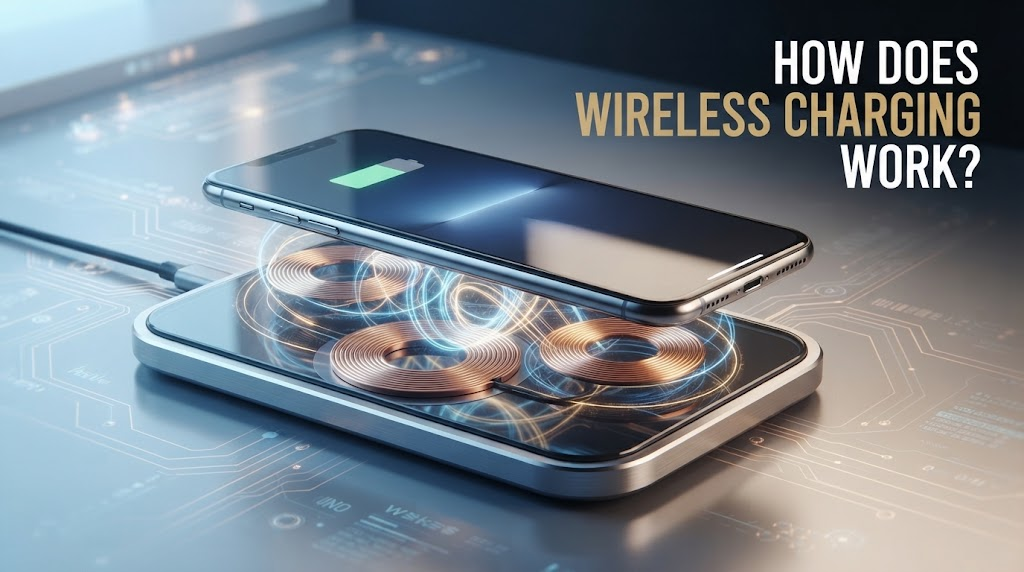
Instead of sending electricity through a physical cable directly into your phone, a wireless charger uses electromagnetic energy to transfer power between two coils. One coil sits inside the charging pad, while another is built into the compatible smartphone or device. The Wireless Power Consortium (WPC) explains that Qi systems use a transmitter coil and receiver coil to transfer energy through a magnetic field.
Understanding how does wireless charging work becomes much easier once you know what happens between these two coils.
How Does Wireless Charging Work?
So, how does wireless charging work in simple terms? A wireless charging pad receives electrical power from a wall adapter and sends that electricity into a transmitter coil. The electrical current flowing through this coil creates a changing magnetic field.
Inside the compatible phone is a receiver coil. When the phone is positioned correctly over the charging pad, the changing magnetic field interacts with the receiver coil and induces an electrical current.
That current is then converted into a form the phone’s battery can use. In other words, the charger transfers energy across a short physical gap without requiring metal contacts between the charging pad and phone.
The basic principle is closely related to electromagnetic induction. The U.S. Department of Energy explains that a changing magnetic field can produce an electrical field, which is fundamental to electromagnetic technology.
The Science Behind Wireless Charging
To understand how does wireless charging work, it helps to look at the two main components: the transmitter and receiver.
The transmitter coil is located inside the wireless charging pad. When the charger receives electricity from its power adapter, electronic circuitry creates an alternating current through the coil.
This alternating current produces a changing magnetic field above the charging surface.
The receiver coil is located inside the smartphone. When it enters the magnetic field, an electrical voltage is induced in the coil. The phone’s charging electronics then process that energy so it can safely charge the battery.
The Wireless Power Consortium describes this process as magnetic induction between the transmitter and receiver coils.
One of the most important factors in how does wireless charging work is alignment.
Wireless charging does not send electricity equally in every direction. The transmitter and receiver coils need to be positioned reasonably close to each other for effective energy transfer.
When the coils are properly aligned, more of the magnetic flux generated by the transmitter reaches the receiver. If the phone is significantly off-center, charging can become slower or less efficient.
The WPC explains that the coupling between the coils depends on factors including their distance, size, shape, and relative alignment.
This is why some wireless charging pads have a clearly marked charging area, while newer magnetic systems help position the phone automatically.
What Is Qi Wireless Charging?
When researching how does wireless charging work, you will frequently encounter the word Qi.
Qi is a wireless charging standard developed by the Wireless Power Consortium. It establishes technical requirements that help compatible chargers and devices communicate and transfer power safely.
A Qi-compatible phone can work with compatible Qi charging equipment, although charging speed and available features depend on the specific device and charger.
The WPC also provides a certified products database where consumers can verify whether products have passed the relevant Qi certification process.
How Do Wireless Chargers Know How Much Power to Send?
Another interesting part of how does wireless charging work is communication between the charger and the device.
Wireless charging is not simply a case of continuously sending maximum power into the phone. The transmitter and receiver communicate to establish whether the device is compatible, whether it needs charging, and how much power is appropriate.
The Qi specification describes communication between the power transmitter and receiver as part of the charging process.
This communication allows the system to adjust power delivery instead of operating blindly.
Modern charging systems can also incorporate safety features designed to detect abnormal conditions and respond appropriately.
Why Do Wireless Chargers Get Warm?
Heat is another important consideration when learning how does wireless charging work.
Some energy is inevitably lost during the transfer process, and part of that energy can appear as heat. Misalignment between the transmitter and receiver coils can also reduce the effectiveness of the transfer.
The distance between the coils matters because stronger coupling generally allows more of the magnetic flux to reach the receiving coil.
A phone may therefore become somewhat warm while charging wirelessly. The exact temperature depends on the phone, charger, case, charging power, room temperature, and other factors.
Keeping the charging area clear and using compatible, properly certified equipment can help provide a more reliable experience.
What Is Qi2 Wireless Charging?
Modern wireless charging has continued to evolve, making how does wireless charging work an increasingly interesting question.
Qi2 is a newer generation of the Qi wireless charging ecosystem. One of its major innovations is the Magnetic Power Profile, which uses magnets to help align the phone and charger.
The Wireless Power Consortium says Qi2 was introduced as a next-generation standard designed to improve wireless charging convenience and efficiency.
The magnets themselves do not transfer the charging power. Instead, they help position the transmitter and receiver coils correctly. The WPC explains that magnetic alignment helps ensure the coils are positioned over each other for better charging performance.
Is Wireless Charging Faster Than Wired Charging?
Whether wireless charging is faster depends on the specific phone, charger, power adapter, and wireless standard.
Wired charging can often provide higher charging power, while wireless charging emphasizes convenience and ease of use. You simply place the device on the charging surface instead of repeatedly plugging in a connector.
Modern standards such as Qi2 have improved wireless charging performance, but charging speed should always be judged according to the specifications of the particular phone and charger.
Therefore, how does wireless charging work is not only a question of technology but also of how efficiently the entire charging system transfers and manages energy.
Does Wireless Charging Damage Your Battery?
Wireless charging itself does not automatically mean that a phone’s battery will be damaged.
Battery aging is influenced by several factors, including temperature, charging patterns, battery chemistry, and the phone’s charging management system. Because wireless charging can generate additional heat under some conditions, thermal management is important.
Using a reputable charger designed for your device and avoiding excessive heat can help maintain a healthy charging environment.
The Wireless Power Consortium also publishes consumer information about wireless charging and battery considerations through its educational resources.
Can Wireless Charging Work Through a Phone Case?
In many cases, yes. Wireless charging can work through common non-metallic materials because the magnetic field can pass through materials such as plastic and glass.
However, very thick cases, metal components, or accessories positioned between the charging coils can interfere with charging performance.
The WPC notes that Qi’s magnetic field can transfer through non-metallic, non-ferrous materials, which is why many ordinary protective cases do not prevent wireless charging.
If a phone charges inconsistently through a case, removing the case temporarily can help determine whether the case is causing the problem.
Where Is Wireless Charging Used?
The answer to how does wireless charging work becomes even more interesting when you look beyond smartphones.
Wireless power technology is used in earbuds, smartwatches, electric toothbrushes, automotive applications, and other electronic products. The same general principle of transferring energy through electromagnetic fields can be adapted to different devices and power requirements.
The U.S. Department of Energy also discusses inductive charging as a technology being explored for electric vehicles, including systems that can transfer electrical energy without a physical charging cable.
This shows that wireless power is not limited to small consumer electronics.
Final Thoughts on How Does Wireless Charging Work
So, how does wireless charging work? It works by using electromagnetic induction to transfer electrical energy between two coils without requiring a physical electrical connection.
The charging pad’s transmitter coil creates a changing magnetic field, while the receiver coil inside the phone captures that energy and converts it into electrical power for the battery. Communication between the charger and device helps manage the charging process, while proper alignment improves energy transfer.
Standards such as Qi and Qi2 have made wireless charging more practical and consistent, while magnetic alignment has made the experience even more convenient.
Ultimately, how does wireless charging work is a fascinating example of electromagnetic principles being turned into an everyday technology. What looks like a simple charging pad is actually a carefully engineered system involving coils, magnetic fields, communication, power conversion, alignment, and safety controls.
FAQs About How Does Wireless Charging Work
How does wireless charging work without a cable?
It transfers energy through a changing magnetic field between a transmitter coil in the charger and a receiver coil inside the device.
Does wireless charging use electricity?
Yes. Electricity powers the transmitter coil, which converts electrical energy into a magnetic field that transfers energy to the receiving device.
Does wireless charging work through a phone case?
Usually, yes, if the case is relatively thin and made from a suitable non-metallic material. Thick or metal cases can interfere with charging.
Is wireless charging safe?
Compatible and properly certified wireless chargers are designed with power-management and safety requirements. Using reputable equipment is recommended.
Is Qi the same as wireless charging?
No. Wireless charging is the broader technology, while Qi is a specific wireless charging standard developed by the Wireless Power Consortium.
MORE RELATED BLOG: