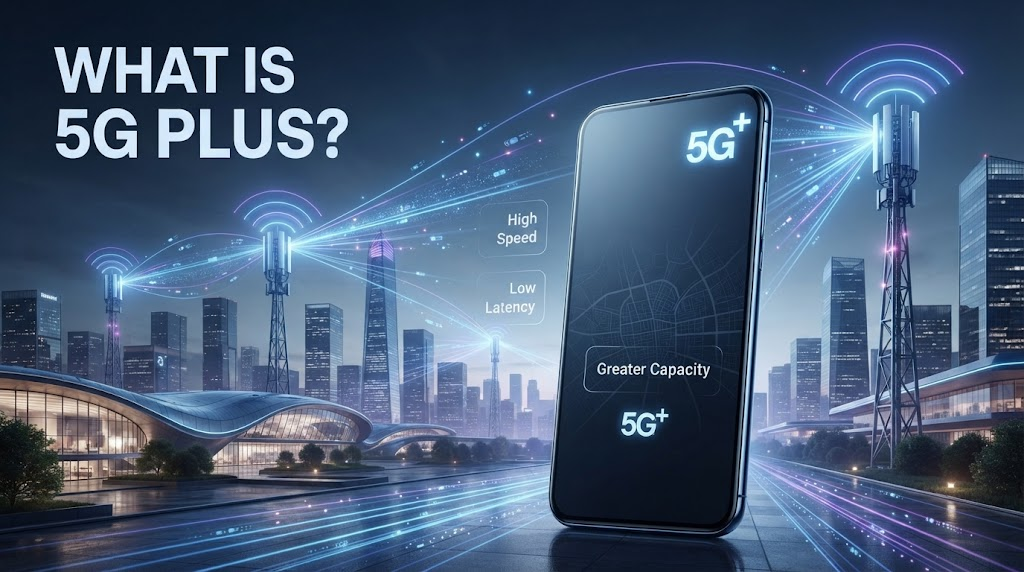
If you have noticed 5G+ appearing next to the cellular signal indicator on your smartphone, you may be wondering what is 5G Plus and whether it is actually different from regular 5G. The short answer is yes, but the exact meaning of 5G Plus depends on the mobile carrier using the term.
In general, what is 5G Plus refers to a carrier’s branding for a more advanced or higher-performance form of 5G. It can use additional spectrum, including mid-band or high-band frequencies, to provide faster speeds, greater capacity, or lower network congestion than basic 5G service.
However, 5G Plus is not a single universal technology with exactly the same specifications everywhere. Different carriers use terms such as 5G+, 5G Ultra Wideband, and 5G Ultra Capacity to identify enhanced portions of their networks.
What Is 5G Plus?
So, what is 5G Plus in simple terms? It is generally a label used by wireless carriers to indicate that your phone is connected to a higher-performance part of their 5G network.
Regular 5G can operate across several types of radio spectrum. Low-band 5G can provide broad coverage and better building penetration, while mid-band and high-band frequencies can offer significantly more capacity and speed.
5G Plus usually indicates that the network is using spectrum or network capabilities that provide an enhanced experience compared with the carrier’s standard 5G service.
The exact definition depends on the carrier. For example, AT&T uses 5G+ for areas where its higher-capacity 5G technologies are available. Verizon uses 5G Ultra Wideband, while T-Mobile commonly uses 5G Ultra Capacity for its higher-performance 5G coverage.
How Does 5G Plus Work?
Understanding what is 5G Plus becomes easier when you understand how cellular spectrum works.
Wireless networks transmit data using radio frequencies. Different frequency bands have different characteristics. Lower frequencies can travel farther and penetrate buildings more effectively, while higher frequencies can carry large amounts of data but generally cover smaller areas.
5G Plus commonly takes advantage of higher-capacity spectrum, particularly mid-band or high-band frequencies. This can allow a cellular network to serve many users simultaneously while maintaining higher data speeds.
The GSMA explains that 5G networks use different spectrum ranges and that mid-band spectrum can provide a useful balance between coverage and capacity.
Is 5G Plus Faster Than Regular 5G?
One of the biggest reasons people search what is 5G Plus is because they want to know whether it is faster.
In many situations, 5G Plus can provide faster download and upload performance than basic low-band 5G. However, actual speeds depend on network congestion, signal strength, spectrum availability, device capabilities, distance from the cell site, and other environmental factors.
A 5G+ icon does not guarantee one specific speed.
For example, two phones connected to 5G Plus could achieve different results because they may be in different locations or connected to different spectrum configurations.
The practical advantage is that enhanced 5G networks generally provide greater capacity and the potential for higher performance.
What Is the Difference Between 5G and 5G Plus?
When asking what is 5G Plus, it is important not to think of 5G+ as an entirely separate generation of wireless technology.
Both are based on 5G cellular technology. The difference usually involves the spectrum, network configuration, and performance level represented by the carrier’s branding.
Basic 5G may use low-band spectrum that prioritizes coverage. 5G Plus may use mid-band or high-band spectrum that prioritizes speed and capacity.
This means your phone can display a normal 5G indicator in one location and 5G+ in another location without changing devices.
What Spectrum Does 5G Plus Use?
The spectrum used by 5G Plus varies by carrier and market.
Mid-band spectrum is particularly important because it offers a compromise between coverage and capacity. It can deliver considerably more capacity than traditional low-band frequencies while covering larger areas than extremely high-frequency signals.
High-band spectrum, sometimes called millimeter wave, can provide very high capacity and impressive peak speeds. However, its range is shorter and obstacles can weaken the signal more easily.
The Federal Communications Commission explains that 5G uses a wide range of spectrum and that different frequency bands have different coverage and capacity characteristics.
Does Every Phone Support 5G Plus?
Not every 5G phone necessarily supports every type of 5G Plus network.
A smartphone’s modem and supported frequency bands determine which cellular networks it can access. Even if a phone supports 5G, it may not support every band or carrier-specific implementation used for enhanced 5G.
Your carrier, phone model, software configuration, and local network availability can therefore determine whether the 5G+ indicator appears.
When buying a new phone, checking the manufacturer’s supported bands and your carrier’s compatibility information is more useful than simply looking for the word “5G.”
Does 5G Plus Use More Battery?
The answer is not always straightforward.
Modern smartphones are designed to manage connections across different cellular technologies and frequencies automatically. When high-performance cellular connectivity is being used heavily, however, the phone may consume more power depending on signal conditions and workload.
Activities such as high-resolution video streaming, large downloads, gaming, and hotspot use can increase battery consumption regardless of whether the connection is 5G or 5G Plus.
Poor signal conditions can also cause a device to work harder to maintain a connection.
Therefore, what is 5G Plus should not be interpreted as “a network that always drains your battery faster.” Actual battery impact depends on how the phone and network are being used.
Does 5G Plus Improve Download Speeds?
In suitable conditions, yes. One of the primary benefits of enhanced 5G is increased network capacity and the potential for faster data transfers.
Downloading large files, streaming high-resolution video, updating applications, or using cloud services can benefit from higher available bandwidth.
However, internet speed is influenced by many factors beyond the cellular network itself. A busy server, weak signal, congested network, or poorly optimized application can limit performance even when the phone displays 5G+.
This is why real-world performance can differ significantly from theoretical maximum speeds.
Does 5G Plus Improve Gaming?
5G Plus can be useful for mobile gaming because higher capacity and improved network performance may support faster data transfers and more consistent connections.
However, speed is only one part of gaming performance. Latency, server location, network congestion, and connection stability can have a major effect on the gaming experience.
A high download speed does not automatically mean zero lag.
For competitive online games, a stable connection with low latency may be more important than achieving the highest possible download speed.
Is 5G Plus Available Everywhere?
No. 5G Plus availability is generally limited to areas where the carrier has deployed the necessary network infrastructure and spectrum.
Enhanced 5G coverage is often concentrated in cities, busy commercial areas, stadiums, airports, transportation hubs, and other locations where additional network capacity is valuable.
Coverage continues to expand as carriers upgrade their networks, but availability varies considerably between countries, cities, and even neighborhoods.
For the most accurate information, users should check their carrier’s official coverage map rather than relying solely on the 5G+ icon.
What Does the 5G+ Symbol Mean on Your Phone?
When 5G+ appears on your smartphone, it generally means that the device has connected to the carrier’s designated enhanced 5G network.
The icon does not necessarily mean that you are receiving the maximum possible 5G speed. Instead, it indicates that the device has detected and connected to a particular network configuration identified by the carrier as 5G+.
The terminology can vary between carriers, which is why the same underlying concept may have different names on different networks.
Is 5G Plus Worth It?
For many users, 5G Plus can provide a noticeable benefit when they are in an area with strong enhanced 5G coverage.
People who frequently download large files, stream high-quality video, use mobile hotspots, participate in cloud-based applications, or connect many devices may benefit from the additional capacity.
For ordinary messaging, email, browsing, and social media, however, standard 5G may already provide more than enough performance.
The value of 5G Plus therefore depends on your location, carrier plan, device, and how heavily you use mobile data.
Final Thoughts on What Is 5G Plus
So, what is 5G Plus? It is generally a carrier-specific name for an enhanced portion of a 5G network that can offer greater capacity, higher speeds, and improved performance compared with basic 5G service.
The exact technology behind 5G+ varies by carrier. Some networks rely heavily on mid-band spectrum, while others may combine different frequency ranges and advanced network technologies.
The most important thing to remember is that 5G Plus is not a completely new generation after 5G. Instead, it represents a higher-performance implementation of 5G that can deliver a better experience when the necessary spectrum, network infrastructure, and compatible device are available.
As carriers continue expanding their 5G networks, enhanced services such as 5G+ should become increasingly common in areas where additional capacity and faster wireless connectivity are needed.
FAQs About What Is 5G Plus
What is 5G Plus?
5G Plus is generally a carrier’s name for a higher-performance 5G connection that can provide greater speed and network capacity.
Is 5G Plus better than 5G?
It can be faster and offer greater capacity than basic 5G, but actual performance depends on the carrier, location, device, signal, and network conditions.
Does 5G Plus cost extra?
Not necessarily. Whether 5G+ requires a specific plan depends on the mobile carrier and its service policies.
Does every 5G phone support 5G Plus?
No. The phone must support the relevant frequency bands and network technologies used by the carrier.
Why does my phone switch between 5G and 5G Plus?
Your phone automatically connects to the available network. It may show 5G+ when enhanced 5G coverage is available and return to regular 5G when that higher-performance network is unavailable.
MORE RELATED BLOG: