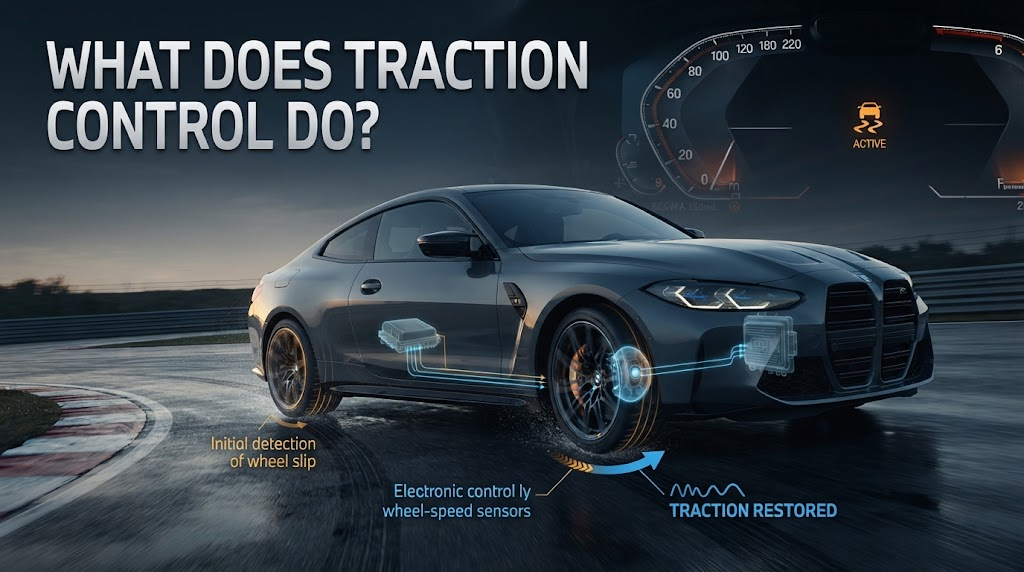
If you have ever accelerated on a wet road and noticed a small traction-control light flashing on your dashboard, you may have wondered what does traction control do? This safety system is designed to help prevent the vehicle’s driven wheels from spinning excessively when they cannot maintain enough grip on the road.
Traction control is especially useful when roads are wet, icy, snowy, sandy, or otherwise slippery. By detecting wheel spin and adjusting engine power or braking individual wheels, the system can help the tires maintain traction.
Understanding what does traction control do is important because it explains why modern vehicles can feel more stable when accelerating on challenging surfaces and why the system should not be confused with anti-lock braking or electronic stability control.
What Does Traction Control Do?
So, what does traction control do in simple terms? It helps prevent the drive wheels from spinning faster than they should when accelerating.
When a tire loses grip, it can begin spinning rapidly while the vehicle itself is not accelerating proportionally. Traction control detects this difference using wheel-speed sensors and intervenes to reduce wheel slip.
Depending on the vehicle, the system may reduce engine torque, apply braking force to a spinning wheel, or use both methods. The goal is to restore useful traction between the tire and road surface.
The National Highway Traffic Safety Administration explains that traction control systems are designed to help prevent wheel spin during acceleration, particularly when traction is limited.
How Does Traction Control Work?
To understand what does traction control do, it helps to look at the technology behind it.
Modern vehicles use wheel-speed sensors to continuously monitor how quickly individual wheels are rotating. The vehicle’s electronic control system compares this information and looks for signs that one or more driven wheels are spinning excessively.
Suppose you accelerate from a stop on a wet road. If one driven tire suddenly rotates much faster than the others, the system can interpret this as wheel slip.
The traction-control system can then respond extremely quickly. Depending on the vehicle, it may reduce engine power or apply the brakes to the affected wheel. Once the tire regains traction, the system can allow normal acceleration to continue.
This happens automatically, often before the driver has time to react.
Why Is Traction Control Important?
The main reason what does traction control do matters to everyday driving is that tire grip can change quickly.
A road may appear dry but contain water, gravel, loose dirt, mud, or other surfaces that reduce traction. During acceleration, these conditions can cause a driven wheel to spin.
Excessive wheel spin can make acceleration less effective and may reduce the driver’s ability to maintain smooth control. Traction control helps manage that wheel slip.
However, traction control does not create additional physical grip. The tires still have a finite amount of traction available. The system simply helps the vehicle use that available grip more effectively.
Traction Control vs. ABS
A common source of confusion when learning what does traction control do is the difference between traction control and anti-lock braking systems, commonly called ABS.
ABS primarily operates during braking. It helps prevent wheels from locking under hard braking so the driver can maintain steering control while slowing down.
Traction control primarily operates during acceleration. It attempts to prevent driven wheels from spinning excessively.
Although they have different purposes, both systems can use wheel-speed sensors and other components to monitor wheel behavior.
The National Highway Traffic Safety Administration describes ABS as a system that helps prevent wheel lock during braking, while electronic stability systems build upon related technologies to help maintain vehicle control.
Traction Control vs. Electronic Stability Control
Another important distinction involves electronic stability control, or ESC.
When considering what does traction control do, remember that traction control primarily focuses on wheel spin during acceleration. ESC has a broader purpose: helping the vehicle follow the driver’s intended direction when it begins to lose directional stability.
ESC can use information from steering angle, vehicle movement, and wheel speeds to determine whether the vehicle is behaving as intended. It may selectively brake individual wheels and reduce engine power when necessary.
Traction control can therefore be considered one part of the broader family of electronic vehicle safety systems.
When Does Traction Control Activate?
Traction control can activate whenever the system detects excessive wheel slip. This is more likely during acceleration on slippery or loose surfaces.
You may notice the traction-control indicator flashing briefly on the dashboard when the system intervenes. Some vehicles may also produce a subtle sensation through the accelerator or drivetrain as engine power is adjusted.
For example, accelerating onto a wet road could cause the tires to momentarily lose grip. The system may detect the wheel-speed difference and intervene until traction improves.
Understanding what does traction control do makes this dashboard behavior much less mysterious.
What Does the Traction Control Light Mean?
The meaning of a traction-control warning light depends on whether it is flashing or remaining illuminated.
A flashing traction-control indicator can mean that the system is actively intervening because wheel slip has been detected. A light that stays on may indicate that traction control has been switched off or that the vehicle has detected a malfunction.
Because dashboard symbols vary between manufacturers, the owner’s manual is the best source for interpreting a specific warning.
If the traction-control warning remains illuminated unexpectedly, especially alongside other warning lights, having the vehicle inspected can help identify the underlying issue.
Should You Turn Traction Control Off?
In normal road driving, keeping traction control enabled is generally recommended.
There can be limited situations where temporarily disabling the system is useful. For example, a vehicle stuck in deep snow, mud, or loose sand may need some controlled wheel spin to help escape.
Some vehicles provide a traction-control button or driving mode that reduces system intervention rather than completely disabling every stability feature.
Because systems differ significantly between vehicles, drivers should follow the manufacturer’s instructions rather than assuming that one procedure applies to every car.
Does Traction Control Work on Snow and Ice?
Traction control can be useful on snow and ice because these surfaces provide less grip than dry pavement.
When a tire starts spinning during acceleration, the system can reduce wheel spin and help the tire regain usable traction.
However, what does traction control do should not be confused with what winter tires or proper driving technique accomplish. Traction control cannot overcome the fundamental lack of grip on extremely slippery surfaces.
Drivers should still accelerate gently, maintain appropriate following distances, and adjust their speed to road conditions.
Does Traction Control Reduce Engine Power?
Yes, reducing engine torque is one method a vehicle can use when traction control detects excessive wheel spin.
The system may temporarily adjust throttle operation, ignition, fuel delivery, or other engine-management parameters depending on the vehicle’s design.
Some vehicles can also brake an individual spinning wheel. The exact strategy varies according to the drivetrain, manufacturer, and traction-control system.
This explains why the vehicle may feel as though it briefly stops accelerating normally when the system activates. The computer is deliberately reducing wheel spin to help restore traction.
Can Traction Control Prevent Accidents?
Traction control can contribute to vehicle safety, but it cannot guarantee that an accident will be prevented.
It is designed to help manage wheel slip during acceleration, not to eliminate every possible cause of a crash.
Speed, tire condition, road surface, weather, driver behavior, visibility, and vehicle condition all affect safety.
The most accurate way to understand what does traction control do is to view it as an additional driver-assistance safety system rather than a replacement for careful driving.
Final Thoughts on What Does Traction Control Do
So, what does traction control do? It monitors wheel behavior and helps prevent excessive wheel spin during acceleration. When the system detects that a driven wheel is losing traction, it can reduce engine power, apply braking force, or use both strategies to help restore grip.
Traction control is particularly useful on wet, snowy, icy, or loose surfaces. It works alongside other vehicle technologies such as ABS and electronic stability control, but each system has a different purpose.
The key point is that what does traction control do is not about creating more tire grip. Instead, the system helps the vehicle manage available traction more effectively, making acceleration smoother and potentially improving control when road conditions are challenging.
For everyday driving, keeping the system enabled and maintaining good tires, appropriate speeds, and safe driving habits provides the best overall approach.
FAQs About What Does Traction Control Do
What does traction control do in a car?
Traction control detects excessive wheel spin during acceleration and can reduce engine power or apply braking to help restore traction.
Is traction control the same as ABS?
No. ABS primarily helps prevent wheel lock during braking, while traction control primarily manages wheel spin during acceleration.
Should traction control always be on?
For normal driving, it is generally best to leave traction control enabled. Some vehicles allow temporary adjustment when dealing with situations such as deep snow or mud.
Why does the traction-control light flash?
A flashing light commonly indicates that the system has detected wheel slip and is actively intervening. Check your vehicle’s owner’s manual for the exact meaning.
Can traction control help on snow?
Yes. It can reduce excessive wheel spin on snow and other slippery surfaces, although it cannot eliminate the limited grip caused by severe winter conditions.
MORE BLOG: