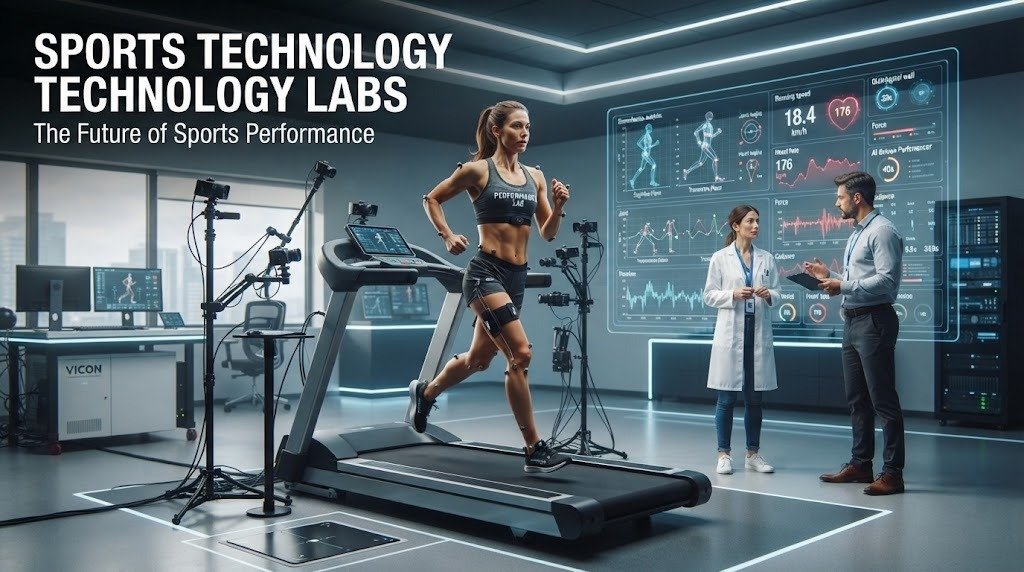
Sports technology labs are specialized environments where scientists, engineers, coaches, designers, and sports professionals work together to study athletic performance and develop new solutions. These laboratories bring together sports science, biomechanics, data analytics, engineering, wearable technology, and artificial intelligence to understand how athletes move and how performance can be improved.
The importance of sports technology labs has grown as modern sports become increasingly data-driven. Coaches no longer rely only on observation and experience. High-speed cameras, motion sensors, force plates, GPS systems, and advanced analytics can provide detailed information about movement, workload, technique, and recovery.
From professional teams to universities and equipment manufacturers, sports technology research is influencing training, injury prevention, equipment design, and the overall athlete experience.
What Are Sports Technology Labs?
Sports technology labs are research and testing facilities dedicated to understanding athletic performance through technology and scientific methods. Their work can range from analyzing a runner’s stride to testing how different materials affect sporting equipment.
A typical laboratory may combine biomechanics equipment with software that records and interprets movement. Researchers can examine variables such as force, speed, acceleration, balance, joint angles, muscle activity, and energy expenditure.
The goal is not simply to collect data. The real value of sports technology labs comes from turning measurements into useful information that athletes and coaches can apply in real training environments.
The Science Behind Sports Technology
Sports technology combines several scientific disciplines. Biomechanics examines how the body moves, while exercise physiology studies how the body responds to physical activity.
Engineering contributes to equipment development, sensor design, materials science, and performance measurement. Computer science and artificial intelligence increasingly help researchers analyze large quantities of athletic data.
Together, these disciplines make sports technology labs important centers for sports innovation.
How Sports Technology Labs Analyze Athletic Performance
One of the most important functions of sports technology labs is performance analysis. Athletes can perform specific movements or exercises while researchers collect information using specialized equipment.
Motion-capture systems can track body movement in three dimensions. High-speed cameras can capture extremely rapid actions that are difficult to analyze with the human eye.
Force plates can measure the forces produced when an athlete jumps, lands, runs, or changes direction. This information can help researchers understand technique and identify movement patterns that may deserve further attention.
Wearable sensors provide another source of information. Depending on the technology, these devices can monitor movement, heart rate, acceleration, workload, and other performance indicators.
Sports Technology Labs and Biomechanics
Biomechanics is one of the foundations of modern sports technology labs. It focuses on the relationship between movement, force, and the human body.
For example, a laboratory studying a sprinter may examine how much force the athlete produces against the ground and how efficiently that force contributes to forward movement.
In golf, researchers might analyze the movement of the golfer and club throughout the swing. In baseball, laboratory testing could examine pitching mechanics or the forces involved during hitting.
This type of analysis can help athletes and coaches understand movement at a level that traditional observation cannot always provide.
The Role of Wearable Technology
Wearable technology has become increasingly important in sports technology labs. Small sensors can now collect information without requiring athletes to remain connected to large laboratory systems.
Wearables may be incorporated into watches, clothing, footwear, protective equipment, or other athletic devices. Researchers can use this technology to study movement in controlled laboratory environments and during real-world training.
The advantage is that athletes can generate performance data while performing naturally. Laboratory testing can then be combined with field data to provide a broader picture of performance.
However, data quality matters. A wearable device is only useful when its measurements are sufficiently accurate for the purpose for which they are being used.
Artificial Intelligence in Sports Technology Labs
Artificial intelligence is creating new opportunities for sports technology labs. Modern AI systems can analyze large datasets and identify patterns that may be difficult for humans to recognize manually.
Computer vision can be used to analyze video footage and estimate body positions. Machine-learning systems can also help researchers classify movement patterns or build models for specific performance applications.
The technology is particularly useful when laboratories collect large amounts of information across multiple training sessions.
Still, AI should support rather than replace professional judgment. A prediction generated by software does not automatically explain why a particular movement occurred or what an athlete should do next.
Sports Technology Labs and Injury Prevention
Injury prevention is another important area of research. Sports technology labs can examine movement mechanics, loading patterns, workload, and other factors associated with athletic stress.
Researchers may study how athletes land from jumps, accelerate, decelerate, or change direction. Such analysis can help identify movement characteristics that warrant further investigation.
It is important to avoid treating laboratory measurements as guarantees of injury prediction. Athletic injuries are complex and can involve training load, previous injuries, biomechanics, recovery, environment, and many other factors.
Instead, laboratory information can contribute to a broader evidence-based approach to athlete monitoring.
Equipment Testing and Product Development
Many sports technology labs are also involved in testing athletic equipment. Footwear, helmets, protective gear, bicycles, bats, racquets, and other products can be evaluated using controlled experiments.
A running-shoe laboratory, for example, might investigate cushioning, traction, energy return, durability, and interaction between the shoe and surface.
Equipment manufacturers can use this information during product development, while independent laboratories can provide testing services or research expertise.
The challenge is ensuring that laboratory results translate into meaningful real-world performance rather than simply producing impressive numbers.
Sports Technology Labs in Universities
Universities play an important role in the development of sports technology labs. Academic laboratories provide environments where researchers can conduct experiments, publish findings, train students, and collaborate with sports organizations.
University research can explore subjects that may take years to develop into commercial products. This creates a bridge between fundamental science and practical sports innovation.
Students studying biomechanics, kinesiology, engineering, exercise science, computer science, and related disciplines can gain valuable experience by working with laboratory equipment and research projects.
Professional Sports and Technology
Professional teams increasingly use technologies associated with sports technology labs to improve training and performance analysis.
Football, basketball, soccer, baseball, athletics, cycling, swimming, and other sports can benefit from detailed measurement and analysis. Teams can combine video, tracking data, physiological information, and athlete testing to support decision-making.
The most effective approach is usually not about collecting as much data as possible. Instead, teams need to identify which measurements answer meaningful questions.
Too much information can overwhelm coaches and athletes. Good sports technology converts complex data into clear and practical insights.
The Future of Sports Technology Labs
The future of sports technology labs will likely involve greater integration between laboratory testing, wearable devices, artificial intelligence, and real-time analytics.
Sensors are becoming smaller, computing power is increasing, and data-processing techniques are becoming more sophisticated. These developments could make performance analysis faster and more accessible.
Virtual and augmented reality may also contribute to training and research. Researchers could potentially study how athletes respond to simulated environments while controlling specific variables.
Another important development will be data privacy. As athletes generate increasingly detailed personal performance information, organizations will need responsible systems for collecting, storing, sharing, and protecting that data.
Why Sports Technology Labs Matter
The greatest contribution of sports technology labs is their ability to connect scientific measurement with practical athletic problems.
Instead of asking only whether an athlete performed well, researchers can investigate why the performance occurred. They can examine movement, forces, workload, equipment, environment, and other variables that influence outcomes.
This approach encourages evidence-based decision-making while allowing coaches and athletes to combine scientific information with experience.
For readers interested in further learning, useful internal resources could include articles about sports biomechanics, wearable fitness technology, AI in sports, athlete performance analysis, and sports injury prevention.
For authoritative background information, resources from organizations such as the can provide additional scientific and technical context.
Conclusion
Sports technology labs are helping transform modern athletics by combining sports science, engineering, biomechanics, data analytics, wearable technology, and artificial intelligence.
Their work can support performance analysis, equipment development, movement research, athlete monitoring, and injury-prevention strategies. More importantly, these laboratories provide a structured way to turn complex measurements into useful knowledge.
As technology continues to advance, sports technology labs will likely become even more connected with everyday training. The future of sports innovation will not simply depend on having more technology, but on using reliable data intelligently and responsibly to help athletes perform, train, and compete more effectively.
FAQs About Sports Technology Labs
What are sports technology labs?
Sports technology labs are specialized research facilities that use science and technology to study athletic performance, movement, equipment, and training.
What technologies are used in sports technology labs?
Common technologies include motion capture, force plates, high-speed cameras, wearable sensors, GPS systems, artificial intelligence, and performance-analysis software.
How do sports technology labs help athletes?
They can provide detailed information about movement, workload, technique, and equipment, helping coaches and athletes make more informed training decisions.
Can sports technology labs predict injuries?
They can study factors associated with injury risk, but laboratory measurements cannot guarantee that an athlete will or will not suffer an injury.
What is the future of sports technology labs?
Future laboratories are likely to combine AI, wearable sensors, real-time analytics, advanced biomechanics, and increasingly personalized performance research.
MORE BLOG: