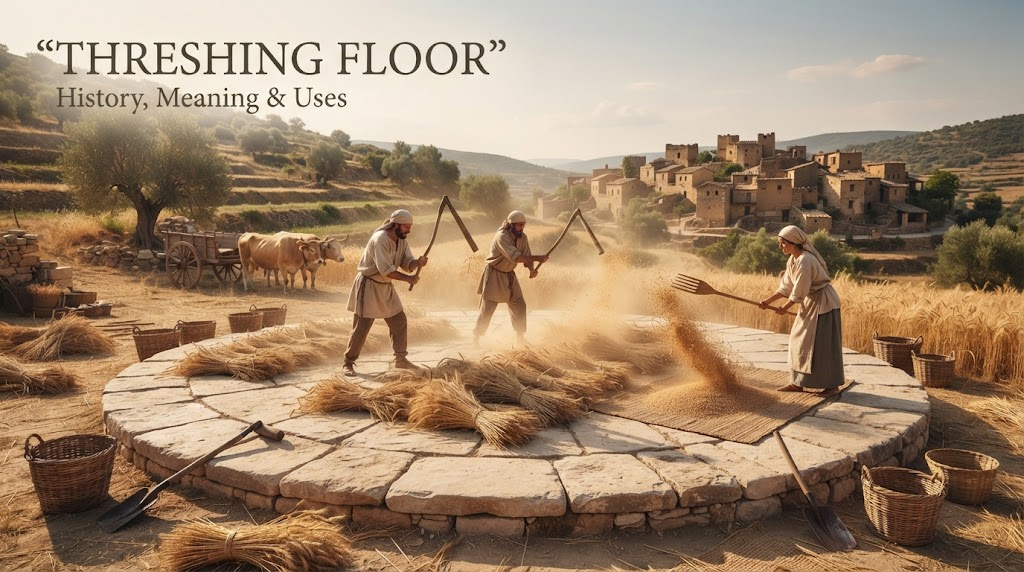
A threshing floor is a traditional agricultural space where harvested grain was separated from the stalks and chaff. Long before modern combines and mechanized farming, this simple area played an essential role in turning harvested crops into usable grain. The concept remains important today because threshing floors offer a fascinating connection between agriculture, rural architecture, history, and ancient daily life.
The design of a threshing floor could vary depending on the region, climate, available materials, and farming traditions. Some were open areas of hard-packed earth, while others were carefully constructed stone or paved surfaces. Their purpose, however, remained broadly similar: provide a durable place where harvested crops could be processed efficiently.
Understanding the threshing floor also helps explain how traditional farming communities organized their work. It was not simply an empty piece of land but a practical agricultural space that could become an important part of rural life.
What Is a Threshing Floor?
A threshing floor is a prepared surface used for threshing harvested crops. Threshing involves separating edible grain or seeds from the stems and other unwanted plant material.
Traditionally, farmers brought bundles of harvested grain to the threshing floor, where the crop could be beaten, trampled, or otherwise processed. Once the grain had been separated, farmers often used winnowing to remove lighter chaff and straw.
The surface needed to be relatively hard and smooth. A soft or uneven surface could allow valuable grain to become mixed with soil, stones, or other debris.
Why Was a Hard Surface Important?
The construction of a threshing floor was closely connected to the mechanics of traditional agriculture. Grain could be damaged or lost if threshing took place directly on loose soil.
A firm surface made it easier to strike or trample the crop and collect the separated grain. It also allowed farmers to sweep and gather small grains that might otherwise disappear into the ground.
Depending on the region, the floor might consist of compacted earth, clay, stone, or another locally available material.
How Did a Threshing Floor Work?
The traditional process began after crops such as wheat or barley had been harvested and dried sufficiently. Bundles were brought to the threshing floor, where the grain-bearing heads were processed.
Threshing could involve beating the harvested stalks with a flail. In some agricultural traditions, animals were also used to trample the crop, helping loosen the grain from the stalks.
After threshing, the mixture contained grain along with pieces of straw and lighter chaff. Farmers could then use winnowing, often taking advantage of natural wind, to separate the heavier grain from lighter material.
This combination of threshing and winnowing made the threshing floor a central stage in traditional grain production.
The History of the Threshing Floor
The history of the threshing floor extends back thousands of years. Grain cultivation became increasingly important as agricultural societies developed, creating a need for reliable methods of processing harvested crops.
Ancient agricultural communities used prepared spaces for separating grain, although their exact construction differed from place to place. Archaeological evidence and historical texts provide insight into how farming communities processed crops before industrial machinery transformed agriculture.
In Mediterranean and Middle Eastern regions, open-air threshing areas were particularly practical because dry weather could support the process. The location and design often reflected local environmental conditions.
The threshing floor therefore represents more than an agricultural tool. It is part of a much larger history of food production and human settlement.
Threshing Floors in Ancient Agriculture
The threshing floor appears in several ancient and historical agricultural contexts. It was especially significant in societies where cereals formed a major part of the diet.
Ancient farmers depended heavily on wheat, barley, and other grains. Processing those crops efficiently was essential because harvested grain could not simply be stored in its original form.
A well-maintained threshing floor helped communities transform harvested plants into a form suitable for storage, milling, cooking, and trade.
The importance of these spaces can also be seen in historical and religious literature. References to threshing floors occur in the Hebrew Bible and other ancient texts, where they sometimes appear as places of economic, social, or symbolic importance.
Threshing Floors in the Bible
The threshing floor has a particularly important place in biblical literature. Several passages mention threshing floors in connection with agriculture, property, ceremonies, and significant historical events.
One well-known example is the threshing floor associated with Araunah in the biblical account of David. According to the Book of Samuel, the site later became connected with the location of the Temple in Jerusalem through the account involving David and the purchase of the threshing floor.
The biblical references demonstrate how an agricultural workplace could also become significant within a broader cultural and historical narrative.
These references should be understood in their historical and religious context rather than assuming that every ancient threshing floor had the same cultural meaning.
Where Were Threshing Floors Located?
The location of a threshing floor was often chosen for practical reasons. An open, exposed area could be useful because wind helped with winnowing.
The surface also needed enough space for harvested crops, workers, and sometimes animals. A location near farmland or a settlement could reduce the effort required to transport harvested bundles.
In hilly or mountainous regions, naturally elevated areas were sometimes useful because they could receive stronger airflow. However, local geography and farming customs determined the final choice.
Traditional Threshing Floor Construction
A traditional threshing floor did not necessarily require sophisticated engineering. In some areas, farmers prepared compacted earth and clay to create a reasonably smooth surface.
Stone construction could provide greater durability. A carefully prepared stone surface could withstand repeated agricultural work and resist erosion better than loose soil.
The construction materials depended heavily on local resources. This is why historical threshing floors can look very different from one another while serving essentially the same agricultural purpose.
The Role of the Threshing Floor in Rural Communities
The threshing floor was often connected to more than crop processing. In traditional farming communities, agricultural work was highly social, with family members, neighbors, and workers contributing to seasonal activities.
Threshing could therefore become a communal task. Several people might work together to process a large quantity of harvested grain within a limited period.
The space could also become associated with seasonal rhythms and local traditions. Its importance extended beyond the physical act of removing grain from stalks.
Threshing Floor vs. Modern Farming
Modern agriculture has dramatically reduced the everyday importance of the threshing floor. Mechanical threshers and combine harvesters can now harvest, thresh, and separate grain far more quickly than traditional methods.
A modern combine performs several tasks during harvesting that once required separate stages. This has made traditional threshing floors largely unnecessary for large-scale commercial farming.
Nevertheless, the traditional process has not completely disappeared. Some small-scale farmers, historical demonstrations, museums, and heritage projects continue to preserve traditional threshing techniques.
Why Threshing Floors Still Matter Today
The threshing floor remains valuable as a historical symbol of agricultural innovation. It represents a period when farming required close observation of weather, crops, soil, animals, and seasonal cycles.
Studying these spaces can help people understand how food moved from fields to households before modern machinery.
Threshing floors can also contribute to the preservation of rural heritage. Historic agricultural structures provide physical evidence of how earlier communities worked and organized their landscapes.
For anyone interested in traditional agriculture, archaeology, or rural history, the threshing floor offers a surprisingly rich subject.
Preserving Historic Threshing Floors
Historic threshing floors can be vulnerable to development, erosion, neglect, and changing land use. Once a traditional agricultural space disappears, valuable information about local farming practices can be lost.
Preservation may involve documenting the structure, protecting the original surface, recording oral histories, and explaining its historical function to visitors.
Museums and heritage organizations can play an important role by presenting threshing floors as part of a wider agricultural story rather than treating them as isolated structures.
Conclusion
The threshing floor was one of the most practical spaces in traditional grain farming. It provided a durable surface where harvested crops could be threshed, separated, and prepared for storage or further processing.
From ancient agriculture to biblical history and rural heritage, the threshing floor has played a role far beyond its simple physical appearance. Its design reflected local materials and environmental conditions, while its use reflected the importance of grain in human societies.
Although modern machinery has largely replaced traditional threshing methods, the threshing floor remains an important reminder of how earlier generations produced food through skill, cooperation, and careful use of natural resources.
FAQs About Threshing Floor
What is a threshing floor?
A threshing floor is a prepared hard surface where harvested grain is separated from stalks and chaff.
What was a threshing floor used for?
It was primarily used to thresh grain and prepare it for winnowing, storage, milling, or consumption.
What were threshing floors made from?
Traditional threshing floors could be made from compacted earth, clay, stone, or other durable local materials.
Why were threshing floors often open?
Open locations allowed wind to assist with winnowing by helping separate lighter chaff from heavier grain.
Are threshing floors still used today?
They are rarely used in large-scale modern farming, but traditional methods remain in some small farms, demonstrations, museums, and heritage settings.
MORE BLOG: