Introduction
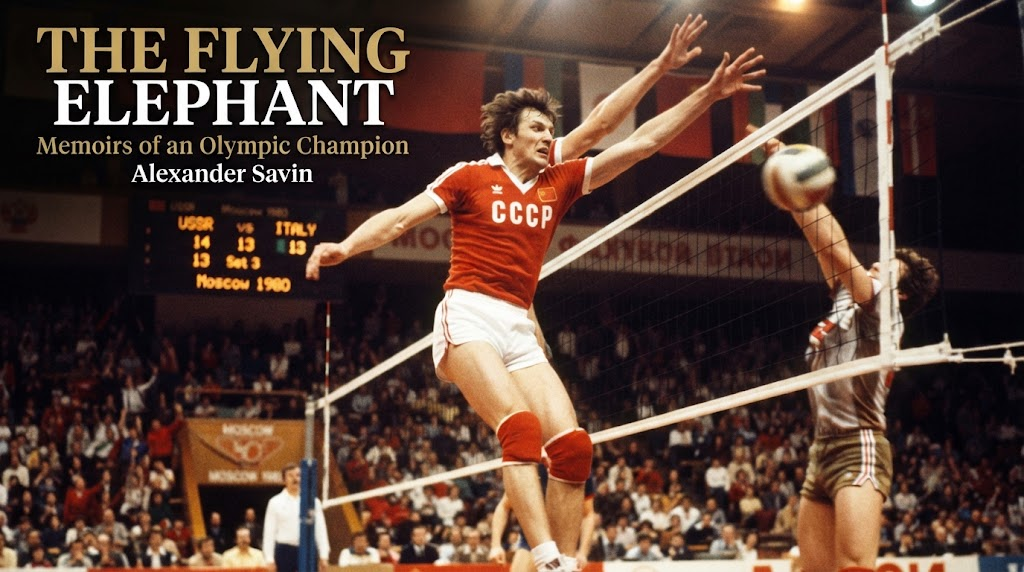
The Flying Elephant Memoirs of an Olympic Champion Alexander Savin introduces readers to the life and sporting journey of Aleksandr Borisovich Savin, one of the outstanding volleyball players of the Soviet era. Savin competed for the Soviet Union at the 1976 Montreal and 1980 Moscow Olympic Games, winning silver in Montreal and gold in Moscow.
What makes The Flying Elephant Memoirs of an Olympic Champion Alexander Savin particularly interesting is the opportunity to look beyond medal tables and match results. Savin’s career unfolded during a remarkable period in international volleyball, when the Soviet men’s team was consistently among the strongest teams in the world.
For readers interested in Olympic history, volleyball, athlete biographies, or Soviet-era sport, the memoir offers a personal route into that history. It connects sporting achievement with preparation, competition, teamwork, pressure, and the experiences that remain hidden behind an Olympic medal.
Who Is Alexander Savin?
Alexander Savin was born on July 1, 1957, in Taganrog, Russia. He became a professional volleyball player and represented the Soviet Union at the highest level of international competition. Olympedia records him at 200 centimeters tall and lists CSKA Moscow among his affiliations.
His Olympic career is especially significant. Savin won a silver medal with the Soviet team at the 1976 Montreal Olympics before returning four years later to win Olympic gold at the 1980 Moscow Games. Those two results provide an important framework for understanding The Flying Elephant Memoirs of an Olympic Champion Alexander Savin.
Savin was also recognized internationally for his contribution to volleyball. The International Volleyball Hall of Fame inducted him in 2010, describing his role in the Soviet team’s return to Olympic glory at Moscow 1980.
The Journey From Olympic Silver to Gold
One of the most compelling aspects of The Flying Elephant Memoirs of an Olympic Champion Alexander Savin is the contrast between Savin’s two Olympic experiences.
At Montreal 1976, the Soviet Union reached the men’s volleyball final but lost to Poland in a five-set match, leaving Savin with a silver medal. The International Volleyball Hall of Fame notes that Savin played in all five of his team’s matches during that Olympic tournament.
Four years later, the situation was dramatically different. At Moscow 1980, the Soviet team went on to win the gold medal, defeating Bulgaria 3–1 in the final. Savin again participated throughout the tournament, playing in all six matches according to the Hall of Fame’s historical account.
That transformation gives The Flying Elephant Memoirs of an Olympic Champion Alexander Savin a powerful narrative foundation. Olympic success is rarely the result of one moment. It is usually built through years of training, tactical development, teamwork, setbacks, and the ability to learn from disappointment.
The Golden Era of Soviet Volleyball
To understand The Flying Elephant Memoirs of an Olympic Champion Alexander Savin, it helps to understand the sporting environment in which Savin competed.
During the late 1970s and early 1980s, the Soviet men’s volleyball program was an international powerhouse. The European Volleyball Confederation identifies Savin as a six-time European champion and notes his Olympic gold in 1980 alongside the silver he earned four years earlier. It also credits him with five Champions Cup victories.
The Soviet team had exceptional continuity and depth. Players such as Vyacheslav Zaytsev, Yuri Panchenko, Vladimir Dorokhov, Oleg Moliboga, Pavel Selivanov, and others formed part of a generation that became closely associated with Soviet volleyball’s international success.
For that reason, The Flying Elephant Memoirs of an Olympic Champion Alexander Savin can be viewed not simply as an athlete’s story but as an entry point into a broader chapter of volleyball history.
What Makes The Flying Elephant Interesting?
The title itself is unusual. The Flying Elephant Memoirs of an Olympic Champion Alexander Savin immediately creates curiosity because the image of an elephant seems almost opposite to the athletic qualities associated with volleyball.
Volleyball, however, is a sport built around movement, timing, jumping, blocking, and explosive power. Savin was particularly known as a middle blocker, a position that demands quick reactions and the ability to influence the game close to the net.
Historical material from the U.S. Congressional Record even included a contemporary description of Savin that emphasized his remarkable leaping ability.
The title therefore feels appropriate as a metaphor for an athlete who combined physical presence with remarkable movement and athleticism.
More Than an Olympic Biography
A major reason readers may be drawn to The Flying Elephant Memoirs of an Olympic Champion Alexander Savin is that sports memoirs can reveal details that statistics cannot.
A medal table tells us that Savin won Olympic silver in 1976 and gold in 1980. It does not fully communicate what it meant to prepare for those competitions, work within an elite team, handle expectations, or experience the difference between finishing second and becoming an Olympic champion.
That human dimension is what makes memoir literature valuable. Instead of viewing an athlete only through achievements, readers can consider the journey that produced those achievements.
The book is also connected to a period when international sport was strongly influenced by Cold War politics. Soviet athletes were competing not only for personal recognition but also within a much larger national sporting system. That historical context adds another layer to Savin’s career.
A Valuable Read for Volleyball Fans
For volleyball enthusiasts, The Flying Elephant Memoirs of an Olympic Champion Alexander Savin has obvious appeal because Savin’s career overlaps with some of the most important years in Soviet volleyball.
His Olympic record alone makes the story notable, while his wider international career places him among the important figures of his generation. The European Volleyball Confederation specifically describes him as one of volleyball’s great middle blockers.
For younger players, the memoir can also be viewed through the lens of sporting development. Elite athletes do not arrive at Olympic competition fully formed. Their careers are shaped by coaches, teammates, repetition, competition, mistakes, and years of disciplined preparation.
That lesson extends well beyond volleyball.
Why the Memoir Still Matters
The continuing interest in The Flying Elephant Memoirs of an Olympic Champion Alexander Savin reflects a broader fascination with first-person sports history.
Modern sports fans have access to statistics, videos, interviews, social media, and instant match analysis. Yet older sporting eras can be difficult to understand because much of the experience was never recorded in the same detail.
A memoir can help bridge that gap. Savin’s career provides a personal perspective on Soviet volleyball and on an Olympic generation whose competitive years are now part of sporting history.
His story also demonstrates an important principle: a career should not be judged by a single result. The silver medal at Montreal was followed by gold at Moscow. The disappointment became part of the road toward a later achievement.
Lessons From Alexander Savin’s Olympic Career
The story behind The Flying Elephant Memoirs of an Olympic Champion Alexander Savin offers several broader lessons about elite performance.
One is resilience. Losing an Olympic final could have defined Savin’s career, but instead it became one chapter before his eventual Olympic triumph.
Another is teamwork. Volleyball is fundamentally a team sport, and even an exceptional individual cannot win an Olympic championship alone. Savin’s achievements were connected to an entire generation of Soviet players and coaches.
The third lesson is consistency. International success requires maintaining a high level of performance across years rather than producing one extraordinary tournament.
These ideas make The Flying Elephant Memoirs of an Olympic Champion Alexander Savin relevant not only to volleyball fans but also to coaches, athletes, sports historians, and readers who enjoy stories about perseverance.
Final Thoughts on The Flying Elephant Memoirs of an Olympic Champion Alexander Savin
The Flying Elephant Memoirs of an Olympic Champion Alexander Savin is best understood within the larger story of Soviet volleyball and Olympic sport. Alexander Savin’s journey from Olympic silver in 1976 to Olympic gold in 1980 provides a natural story of persistence, competition, and achievement.
His legacy is supported by major volleyball and Olympic-history records. Olympedia lists his two Olympic medals, while the International Volleyball Hall of Fame recognizes his contribution to the Soviet team’s 1980 Olympic victory.
For anyone interested in Olympic volleyball, Soviet sporting history, or the personal experiences behind elite competition, The Flying Elephant Memoirs of an Olympic Champion Alexander Savin offers an intriguing subject. Ultimately
more related blog