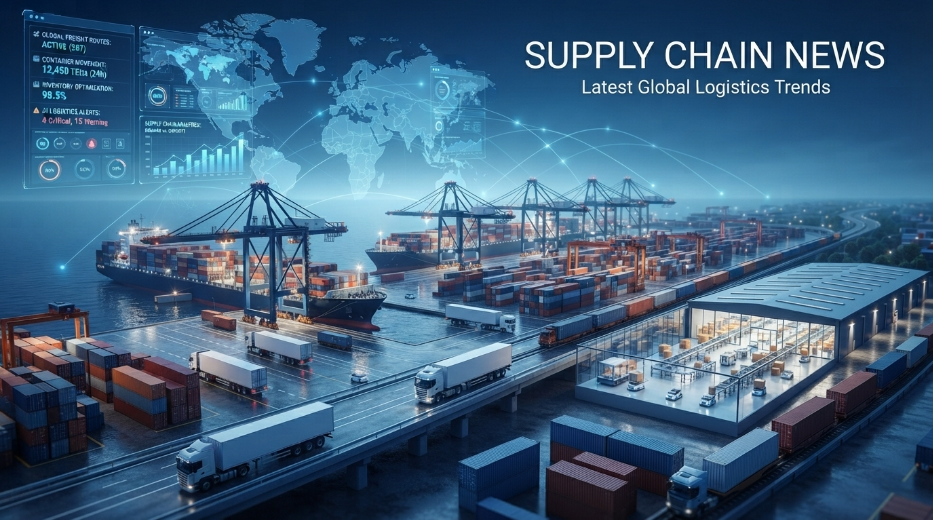
Supply chain news has become increasingly important for businesses, manufacturers, retailers, investors, and consumers because disruptions in transportation, trade policy, energy markets, and manufacturing can quickly affect prices and product availability. In 2026, global supply networks are dealing with a complicated combination of geopolitical tensions, tariff changes, shipping disruptions, technology investment, and changing consumer demand.
Recent trade data shows that global merchandise trade remained surprisingly resilient in the first quarter of 2026, with strong demand for AI-related electronic components helping offset some negative effects from Middle East disruptions. At the same time, major shipping routes are facing greater uncertainty, making supply chain news especially valuable for companies planning procurement, transportation, and inventory.
Why Supply Chain News Matters in 2026
The modern supply chain is a connected global system. A disruption at a major port, canal, factory, refinery, or transportation corridor can influence companies thousands of miles away.
Current supply chain news shows that businesses are increasingly moving away from a purely cost-focused approach. Instead, companies are placing greater emphasis on resilience, supplier diversification, inventory visibility, and alternative transportation routes.
The International Monetary Fund has highlighted how shipping and transportation disruptions can increase supply-chain costs and affect consumers through higher prices for goods and essentials.
This shift is changing how companies think about efficiency. The cheapest supplier or fastest route is no longer automatically the best choice if a disruption could stop production.
Global Shipping Remains a Major Supply Chain Story
One of the most important themes in current supply chain news is the continuing uncertainty surrounding international ocean transportation.
Shipping routes around the Red Sea and other strategic waterways have been affected by geopolitical instability. When vessels avoid a major route and take longer alternatives, transit times, fuel consumption, vessel availability, and freight costs can all change.
Recent freight-market analysis has also pointed to uncertainty around the Strait of Hormuz, tariff deadlines, and differences in peak-season demand across shipping lanes.
For importers and exporters, these developments mean that transportation planning increasingly requires multiple scenarios rather than relying on one predictable route.
Ports Are Seeing Changing Demand
Port activity is another major area to watch in supply chain news. The Port of Los Angeles reported its second-highest July volume on record in 2026, with strong imports linked not only to consumer products but also to batteries, renewable-energy equipment, and components associated with AI infrastructure.
This illustrates an important change in global logistics. Supply chains are not simply moving traditional retail merchandise. New investment in artificial intelligence, electrification, renewable energy, and data centers is creating additional demand for specialized equipment and components.
Tariffs Are Reshaping Sourcing Decisions
Trade policy remains another major focus of supply chain news. Tariffs can change the economics of sourcing products from particular countries, encouraging manufacturers and retailers to reconsider where they purchase components and finished goods.
Companies may respond by finding alternative suppliers, changing production locations, increasing inventory before tariff changes, or redesigning products to reduce exposure to additional costs.
DHL notes that tariff changes have encouraged businesses to reassess sourcing strategies and develop alternatives to highly concentrated supply networks.
The result is a broader movement toward supply-chain diversification rather than dependence on one country or supplier.
AI Is Becoming a Supply Chain Driver
Artificial intelligence is emerging as an unusual but increasingly important theme in supply chain news.
AI does not only affect software companies. The expansion of data centers requires enormous quantities of servers, processors, networking equipment, electricity infrastructure, cooling systems, and specialized components.
The WTO reported that trade in AI-enabling goods increased by more than 40% year over year in value terms during the first quarter of 2026.
This growth creates new logistics requirements. Manufacturers must secure specialized components while logistics providers need to move high-value equipment efficiently and reliably.
AI is also being used directly within supply-chain operations. Companies are applying predictive analytics to demand forecasting, warehouse management, transportation planning, inventory optimization, and supplier-risk monitoring.
Warehouse Automation Is Accelerating
Another important development in supply chain news is the growing use of warehouse automation.
Businesses are investing in robots and automated systems to improve productivity, handle labor shortages, and process orders faster. Recent reporting indicates that North American warehouse operators are increasing automation investment as labor costs and expectations for faster deliveries remain significant pressures.
Automation can include robotic picking systems, autonomous mobile robots, automated storage and retrieval systems, computer vision, and software that coordinates warehouse activities.
The goal is not simply to replace workers. Modern warehouse automation can allow employees to focus on tasks that require judgment, supervision, maintenance, customer service, and problem-solving.
Supply Chain Resilience Is Becoming Essential
The central lesson from today’s supply chain news is that resilience has become a strategic requirement.
A resilient supply chain can continue operating when a supplier fails, transportation costs suddenly rise, a port becomes congested, or geopolitical events disrupt a major route.
Companies are therefore examining supplier concentration, alternative transportation routes, safety-stock levels, and real-time visibility. Some are also developing regional manufacturing networks to reduce dependence on long-distance international transportation.
Recent industry analysis describes global supply chains as undergoing a structural transformation influenced by geopolitical tensions, trade changes, and climate-related volatility.
The Importance of Supply Chain Visibility
Technology is helping businesses respond to these challenges. Real-time tracking systems can provide information about shipments, inventory, warehouse capacity, and transportation conditions.
Better visibility allows companies to identify potential delays earlier and make decisions before a disruption becomes a serious operational problem.
For example, if a shipment is delayed at a port, a business with strong visibility may be able to redirect inventory, change the transportation method, adjust production schedules, or notify customers before the delay becomes critical.
This makes digital supply-chain management one of the most important long-term trends covered by supply chain news.
Global Trade Is Slowing but Not Standing Still
The broader economic environment remains complicated. The IMF’s July 2026 outlook projects world trade volume growth to slow from 5.0% in 2025 to 3.5% in 2026 before recovering to 4.3% in 2027. The organization points to tariffs, trade rerouting, and changing production chains among the factors influencing the outlook.
Meanwhile, the WTO’s March baseline forecast projected merchandise trade growth of 1.9% in 2026, illustrating how different assumptions and forecast periods can produce different estimates.
For businesses, the broader message is more important than any single forecast: international trade continues, but its routes, costs, and risk patterns are changing.
What Businesses Should Watch Next
Future supply chain news is likely to remain focused on geopolitical developments, tariff negotiations, freight rates, port congestion, energy costs, AI-related demand, automation, and climate-related transportation risks.
Companies that monitor these factors can make better purchasing and inventory decisions. Businesses that rely entirely on historical patterns may find themselves less prepared for sudden changes.
The most effective supply-chain strategies increasingly combine reliable suppliers, diversified sourcing, technology, accurate forecasting, and contingency planning.
Conclusion
Today’s supply chain news demonstrates that global logistics is entering a period of continued transformation. Geopolitical tensions, trade policies, changing shipping routes, AI investment, warehouse automation, and climate pressures are all influencing how products move around the world.
The biggest change is the growing importance of resilience. Businesses are no longer asking only how cheaply or quickly they can move goods. They are also asking whether their networks can continue operating when conditions change.
For companies, investors, and professionals following global commerce, keeping up with supply chain news can provide valuable insight into transportation costs, sourcing decisions, inventory planning, manufacturing trends, and the broader global economy.
FAQs About Supply Chain News
What is supply chain news?
Supply chain news covers developments affecting manufacturing, sourcing, transportation, logistics, warehousing, inventory, trade, and product distribution.
Why is supply chain news important?
It helps businesses understand disruptions, transportation changes, tariffs, supplier risks, technology developments, and other factors that can affect costs and product availability.
What are the biggest supply chain trends in 2026?
Major trends include supply-chain diversification, shipping-route disruption, AI-related demand, warehouse automation, digital visibility, and greater focus on resilience.
How does AI affect supply chains?
AI can improve demand forecasting, inventory planning, warehouse operations, transportation management, and supply-risk analysis while also creating new demand for technology components.
Are global supply chains becoming more regional?
Many businesses are exploring regional sourcing and manufacturing to reduce exposure to geopolitical and transportation risks, although global trade remains an important part of the economy.
MORE RELATED BLOG: