Introduction
The terms villa and house are often used interchangeably, but they can describe different styles of residential living depending on the country, location, architecture, and real estate market. A house is a broad term for a residential property, while a villa traditionally suggests a more spacious or distinctive home, often associated with gardens, privacy, outdoor areas, or resort-style living.
Today, the meaning of villa and house can vary considerably. Oxford describes a villa as a country house with a large garden, a holiday residence, or, in some contexts, a large town house. This means that the word “villa” does not always describe one fixed architectural design.
Understanding villa and house differences can help buyers, renters, investors, and travelers make better decisions. Factors such as space, privacy, maintenance, location, lifestyle, and budget all influence which type of property is more suitable.
What Is a Villa?
A villa is generally associated with a spacious private residence, often featuring gardens, terraces, balconies, courtyards, pools, or substantial outdoor areas. Historically, the word comes from the Latin concept of a country house and became strongly associated with elegant residences in Europe.
In modern real estate, a villa and house comparison can become complicated because “villa” is sometimes used as a marketing term. A property may be called a villa because of its architecture, location, landscaping, or premium amenities rather than because it follows a strict architectural definition.
Some villas are completely detached, while others may be semi-detached or located within planned residential communities. In holiday destinations, villas are also commonly offered as private vacation accommodations.
What Is a House?
A house is a much broader residential category. It can refer to a detached property, semi-detached home, townhouse, or another structure designed for people to live in.
For example, the U.S. Census Bureau distinguishes between different structural types, including single-family houses that may be detached or attached. A detached one-unit house generally has open space around its sides, while attached homes share a wall with another structure.
This distinction is important when researching villa and house properties because a villa can technically be a type of house. The main difference is often the property’s design, scale, setting, and intended lifestyle rather than the basic fact that it is a residence.
Villa and House: Key Differences
When comparing villa and house, the first major difference is usually space. Villas tend to emphasize generous floor plans and outdoor living, although this is not universal. A conventional house can be compact, while another house may be larger than many villas.
Privacy is another common distinction. Many villas are designed with private gardens, boundary walls, driveways, terraces, or swimming pools. A standard house may have some of these features, but they are not necessarily central to the design.
Location also influences the meaning of villa and house. Villas are frequently associated with suburban areas, coastal destinations, countryside locations, gated communities, and holiday resorts. Houses can be found almost anywhere, from dense urban neighborhoods to rural communities.
Villa and House Architecture
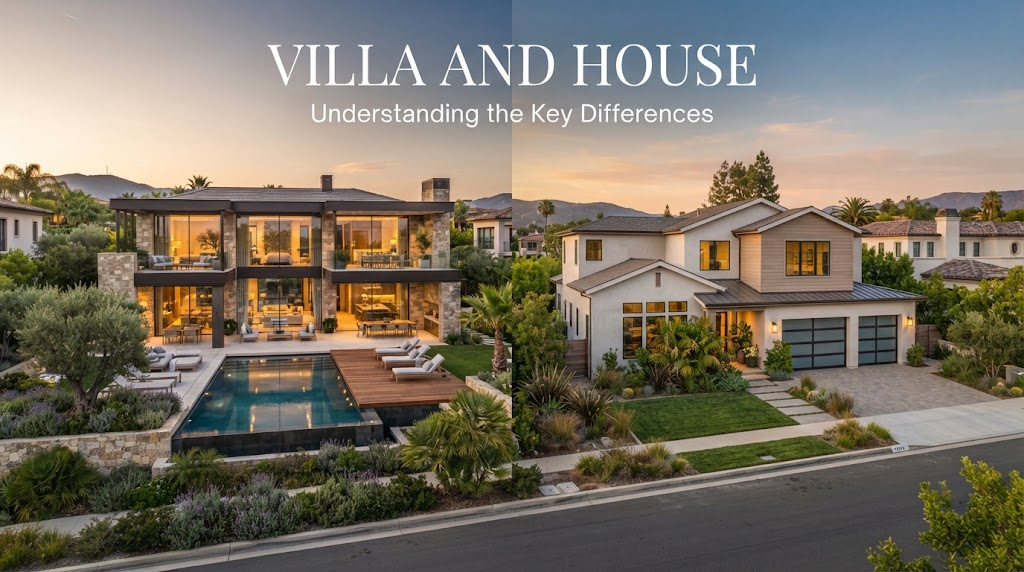
Architecture is one of the most visible aspects of a villa and house comparison. Villas may incorporate large windows, open-plan living areas, spacious terraces, landscaped gardens, columns, courtyards, or Mediterranean-inspired details.
Modern villas can look completely different from traditional European designs. Contemporary versions often use clean lines, glass walls, flat roofs, natural materials, and indoor-outdoor layouts.
A conventional house can also use these architectural features. Therefore, appearance alone does not always establish whether a property should technically be called a villa.
Space, Privacy, and Outdoor Living
For many buyers, outdoor space is one of the strongest attractions of a villa and house. A villa may provide a private garden, swimming pool, patio, rooftop terrace, or landscaped courtyard.
This type of layout can be especially appealing to families who enjoy entertaining outdoors or people who want a quieter residential environment.
However, more space also means more responsibility. Larger gardens, pools, terraces, and exterior surfaces require regular cleaning, landscaping, repairs, and maintenance. A smaller house may therefore be easier and less expensive to manage.
Villa and House Costs
The cost of a villa and house depends heavily on location, land value, construction quality, property size, amenities, and local demand. It would be misleading to say that every villa is automatically more expensive than every house.
A villa with a large plot, private pool, premium finishes, and a desirable location will generally require a larger budget than a modest home. At the same time, a luxury detached house in a major city can cost significantly more than a villa in a less expensive market.
Buyers should consider the total cost of ownership rather than focusing only on the purchase price. Property taxes, insurance, utilities, repairs, landscaping, security, and community fees can all affect the long-term financial picture.
Villa and House for Families
Families comparing villa and house options often prioritize bedrooms, bathrooms, storage, parking, gardens, schools, transportation, and neighborhood safety.
A villa may offer more room for children, guests, home offices, and outdoor activities. A conventional house can provide similar advantages if its floor plan and location meet the family’s needs.
The most practical choice depends on how the property will actually be used. A large residence may sound attractive, but unnecessary space can increase maintenance and operating costs.
Villa and House as an Investment
Property investors may also compare villa and house opportunities based on rental demand, location, property condition, and potential returns.
A villa in a popular tourism destination can have strong short-term rental potential, particularly when it offers privacy, outdoor amenities, and convenient access to attractions. However, vacation rentals can involve additional management, cleaning, marketing, and regulatory considerations.
Long-term residential houses may provide a different investment profile, particularly in areas with stable demand from families and professionals. Investors should research local property regulations, rental rules, taxes, insurance requirements, and market conditions before purchasing.
Choosing Between a Villa and a House
The best choice in a villa and house comparison depends on lifestyle rather than the label attached to the property.
Someone who values privacy, entertaining space, gardens, and resort-style amenities may prefer a villa. Someone who prioritizes affordability, convenience, lower maintenance, or proximity to urban services may prefer a conventional house.
Location should also receive serious attention. A beautiful property in an inconvenient area may be less practical than a smaller home close to work, schools, shopping, transportation, and essential services.
Before making a decision, prospective buyers should inspect the property’s structure, utilities, drainage, roofing, electrical systems, plumbing, and surrounding land. Professional inspections can help identify issues that may not be obvious during a casual viewing.
Why Property Terminology Matters
Understanding residential terminology makes it easier to evaluate villa and house listings accurately. Real estate descriptions can use attractive language, but buyers should look beyond labels and examine the actual property characteristics.
Government housing classifications demonstrate that residential structures can be categorized according to physical characteristics such as whether a home is detached or attached.
For additional housing terminology and structural definitions, readers can consult authoritative resources such as the
If your website has related articles about home buying, property investment, interior design, or real estate trends, those pages can also be used as internal links around relevant phrases such as “home buying guide,” “property investment,” and “modern home design.”
Final Thoughts on Villa and House
The villa and house distinction is not always as simple as comparing two completely separate property types. A villa can itself be a house, while the term villa often communicates additional ideas about space, privacy, design, location, and lifestyle.
The right property depends on your budget, family requirements, preferred location, maintenance expectations, and long-term goals. Instead of choosing a property simply because it is advertised as a villa or house, examine its actual features and total ownership costs.
Whether you choose a spacious villa or a practical house, a successful property decision comes from matching the home with the way you intend to live.
Frequently Asked Questions About Villa and House
What is the main difference between a villa and a house?
A house is a broad term for a residential property, while a villa usually suggests a more spacious or distinctive residence with features such as gardens, terraces, privacy, or premium amenities.
Is a villa always bigger than a house?
No. “Villa” does not guarantee a specific size. Some villas are large, while some are relatively modest. The terminology varies between countries and real estate markets.
Is a villa more expensive than a house?
Not necessarily. Prices depend on location, land size, construction quality, amenities, and local demand. A luxury house can cost much more than a smaller villa.
Is a villa good for families?
A villa can be excellent for families because many offer larger living areas, private outdoor space, multiple bedrooms, and greater privacy. However, maintenance costs should also be considered.
Can a villa be a good investment?
A villa can be a good investment when location, demand, purchase price, rental potential, operating costs, and local regulations support the investment. Proper research is essential before buying.